Back to School in China: What Actually Happens on September 1st
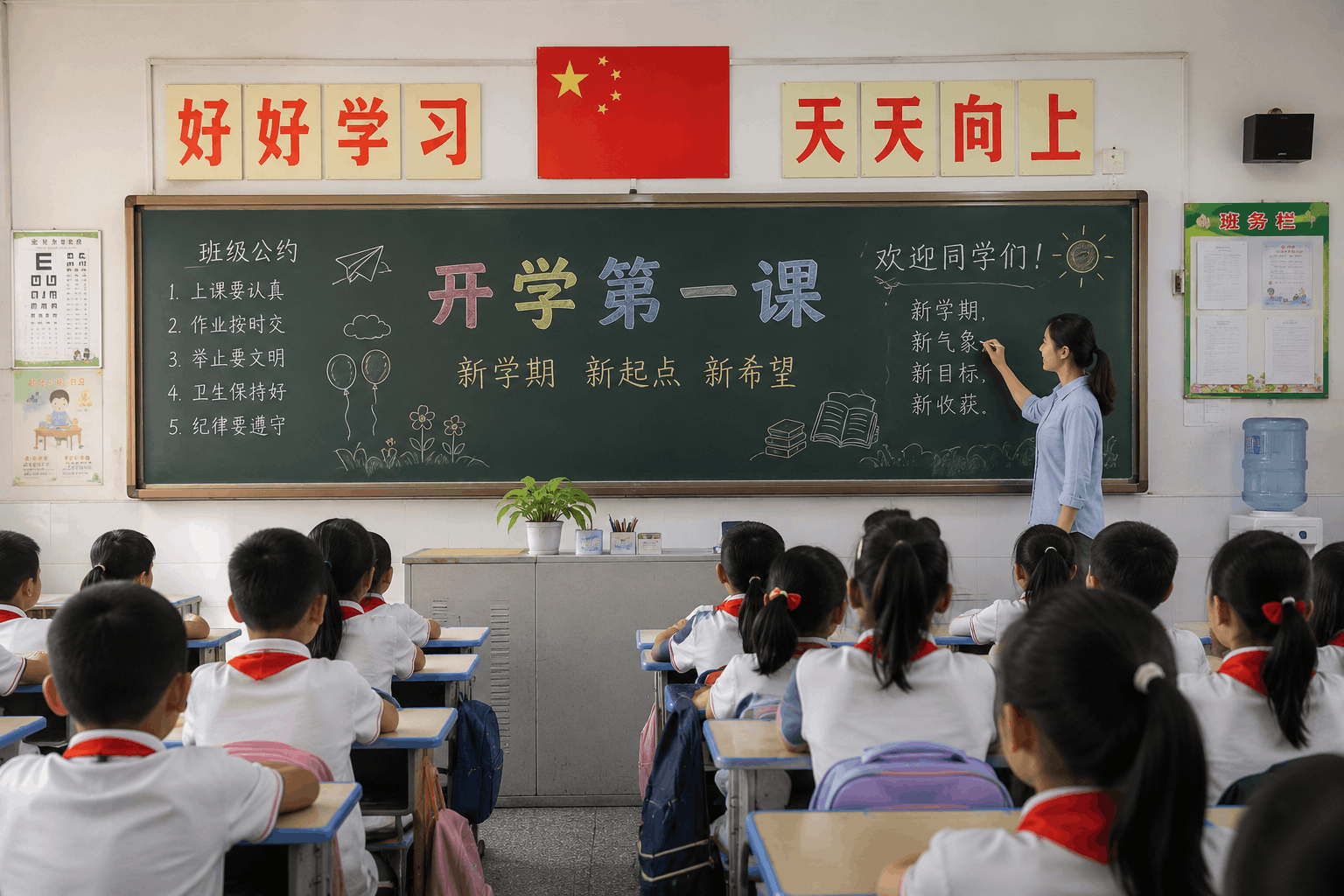
In most countries the school year trickles back into life over a couple of weeks, with every district picking its own date. China leaves no room for debate: term starts on September 1st, and in 2026 that's a Tuesday. One country, from subtropical Guangzhou to freezing Harbin, walking into class on the same morning.
The moment even has its own name: 开学季 (kāixuéjì), "back-to-school season." It shows up in headlines, ad campaigns, and roughly half of Douyin in late August. If you're learning Chinese, it's one of the best weeks of the year to read real news — the vocabulary repeats, the context is obvious, and the articles are short.
Key dates for the 2026-2027 year
Primary and secondary schools (小学, 初中, 高中):
- August 30-31 — 报到, registration day. No lessons yet.
- September 1st — the first real day of class, almost everywhere.
- August 20 — Tibet, the earliest exception, for climate reasons.
- Mid-to-late August — exam years (高三 and 初三) come back early.
There are minor provincial variations — Gansu usually starts around August 24, Yunnan on the 31st — but the overwhelming majority, Beijing, Shanghai and Guangdong included, stick to September 1st.
Universities: here the uniformity collapses entirely. Every campus runs its own calendar, and the spread is enormous. Westlake University welcomed its 2026 freshmen on August 7th, while at other institutions first-years don't sit through a real subject lecture until late September.
At Peking University, the 2026 intake did military training from August 22 to September 2, attended the opening ceremony on the 4th, and started classes on the 7th.
报到: the day before the day
报到 (bàodào) has no clean English equivalent. It's "reporting in" day: students go to school, confirm their enrolment, find out which class they've been assigned to, collect their new textbooks, and clean the classroom together. No lessons. It's pure logistics — and for a lot of students it's the emotionally significant day, because it's when you see your classmates again.
The next morning, September 1st, everyone walks in with a timetable and gets straight to work.
开学第一课: the show the whole country watches
On the evening of September 1st, state broadcaster CCTV airs 开学第一课 ("First Lesson of the New Term"), an educational programme that many schools assign as compulsory homework. Each year takes a theme — science, history, the environment — and mixes celebrity guests with scientists and personal stories.
For a Chinese learner it's excellent listening material: clear diction, character subtitles, and a pace designed for children.
军训: three weeks marching in the sun
If one image defines starting university in China, it's this one: hundreds of eighteen-year-olds in camouflage fatigues, standing in formation on the sports field in 35-degree heat.
军训 (jūnxùn), military training, is compulsory for every first-year undergraduate and typically runs two to three weeks. It happens before real classes begin. Expect marching, formation drills, saluting, some national defence theory, and an enormous amount of standing still.
Real examples from this year: Henan University runs 军训 from August 31 to September 20, with classes starting on the 21st. Zhengzhou University runs it September 7-24.
Students hate it and remember it fondly in roughly equal measure. It ends with a graduation parade, group photos in uniform, and a sunburn that lasts into October.
录取通知书: the letter that became a collector's item
Before any of this comes the 录取通知书 (lùqǔ tōngzhīshū), the admission letter. And in China it is emphatically not an email attachment.
Universities compete to send the most spectacular one. Tsinghua sends a 3D pop-up model of one of its campus buildings. Others include rice seeds, Chinese ink, laser-engraved bookmarks, or lacquered boxes. The unboxing gets filmed and posted. It is, genuinely, a video genre.
Behind that envelope sit two days in June: the 高考 (gāokǎo), the national university entrance exam you've probably heard about.
开学季 vocabulary
These are the words you'll see over and over if you read Chinese news in September:
- 开学 (kāixué) — term starts, go back to school
- 开学季 (kāixuéjì) — back-to-school season
- 报到 (bàodào) — to report in, register
- 新生 (xīnshēng) — new student, freshman
- 老生 (lǎoshēng) — returning student
- 军训 (jūnxùn) — military training
- 宿舍 (sùshè) — dormitory
- 室友 (shìyǒu) — roommate
- 选课 (xuǎnkè) — to choose or register for courses
- 课表 (kèbiǎo) — class timetable
- 教材 (jiàocái) — textbook
- 班主任 (bānzhǔrèn) — homeroom teacher
- 录取通知书 (lùqǔ tōngzhīshū) — admission letter
- 高考 (gāokǎo) — university entrance exam
- 暑假 (shǔjià) — summer holiday
The year names, which confuse everyone:
- 小学 (xiǎoxué) — primary, 6 years
- 初中 (chūzhōng) — junior high, 3 years: 初一, 初二, 初三
- 高中 (gāozhōng) — senior high, 3 years: 高一, 高二, 高三
- University — 大一, 大二, 大三, 大四 (years 1 to 4)
Notice the pattern: level + number. 高三 is literally "senior-high three" — the 高考 year, and the most feared in the entire system.
What surprises Western readers most
- The day is very long. Many high schools run from about 7:30 to 17:30, with two more hours of supervised evening study for exam years.
- The class is a fixed group. Students don't move rooms — teachers do. Your 班 is your family for three years.
- Morning exercises. Many schools still do collective callisthenics in the yard, music piped over the PA.
- The uniform is a tracksuit. No blazers: the standard Chinese school uniform is a loose, comfortable, unisex tracksuit.
Frequently asked questions
When does the school year start in China?
September 1st, nationwide, for primary and secondary schools. Registration (报到) happens on August 30 or 31. Universities set their own dates, anywhere from early August to late September.
How long is summer holiday in China?
About seven weeks, roughly mid-July to August 31. Winter holiday, around Chinese New Year, is about four weeks.
Is military training compulsory at Chinese universities?
Yes. All first-year undergraduates do 军训, usually two to three weeks before classes begin.
What does 开学 mean?
"To start term" or "go back to school." 开 means "open" and 学 means "study" — literally, "opening the studying."